Showing posts with label Arms Control. Show all posts

Tuesday, June 12, 2018

Pie Crust Promises: Nuclear Edition

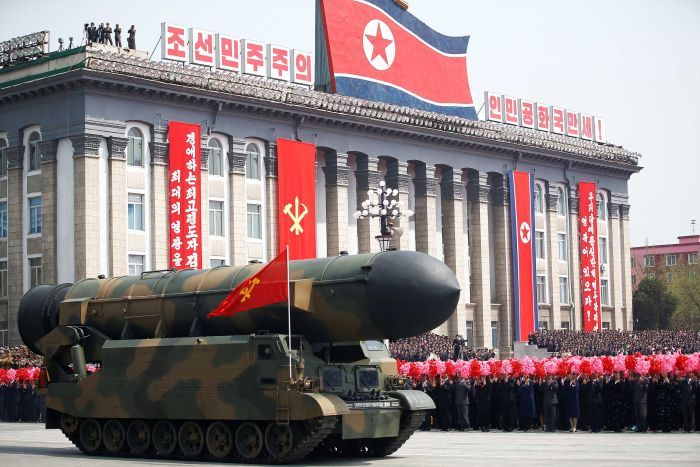
So the Trump Administration has signed a joint agreement with North Korea pledging to work towards denuclearization of the Korean peninsula. That sounds great - fewer nuclear weapons is a good thing. But even leaving aside the other problematic aspects of this "agreement" (like the US unilaterally giving up military exercises), Kim Jong Un's promise to talk about giving up his nukes reminds me of Mary Poppins' 'pie crust promise': easily made, easily broken.

Yes, I once published a journal article with that title along with my good friend Steve Saideman. I think there should be a prize for publishing an article with a Mary Poppins reference.

For those inclined to take North Korea's pledge seriously, I would direct you to Article VI of the Treaty on the Non-Proliferation of Nuclear Weapons (the NPT treaty, created in 1968 and still in force today):

Article VI
Each of the Parties to the Treaty undertakes to pursue negotiations in good faith on effective measures relating to cessation of the nuclear arms race at an early date and to nuclear disarmament, and on a treaty on general and complete disarmament under strict and effective international control. [emphasis added]

The United States is a Party to this treaty, as are Britain, France, China, and Russia (the other recognized "nuclear states"). None has ever seriously contemplated a treaty on nuclear disarmament, outside of a brief rhetorical flirtation by the Reagan administration during a summit with Michael Gorbachev in the 1980s. There haven't even been serious international negotiations on drawing down nuclear stockpiles since the early 1990s.

All of this is simply to say that arms control promises - even in treaty form, much less in a joint communique following a meeting - are easy to make and equally easy to break. Which suggests that the news cycle of the past 24 hours really didn't tell us very much at all.

Wednesday, August 2, 2017

Can We Ignore North Korea?

A good friend of mine posted this question to FB today. Since a decent answer requires more than should be put into a FB comment section, I'm writing out my thoughts here.

OK, honest question for the many people in my feed who are smarter about international stuff than I am. 
Hypothetically, what if the US were to just ignore North Korea? No threatening, no assisting, no engaging, nothing? Just maintain our relationship with South Korea and nothing else?
Would that still create an unacceptable risk for South Korea? Would it destabilize our relationship with China?
There are obvious humanitarian reasons not to follow this course, so I'm not advocating anything -- I just want to better understand how the cogs fit together. Smart people, please educate me.


Like all questions of foreign policy, answering this one depends very much on what your goals are. The Trump administration hasn't been very clear in articulating its goals towards North Korea, but my sense is that they haven't shifted very much from where past administrations have been. Those goals reasonably include, or could include, the following:

1) Avoid war in the Korean peninsula (which would be horrendously catastrophic for everybody, and would result in millions of deaths).

2) Prevent North Korea from attacking the United States with a nuclear weapon.

3) Prevent North Korea from developing a deployable nuclear weapon. Barring this, prevent it from developing such a weapon that can be delivered to the United States.

4) Bring about regime change in North Korea, with a possible eye towards reunifying the peninsula.

#4 is, for all intents and purposes, out of bounds. The Kim regime in Pyongyang desires its survival in power above all else, and it has had a credible conventional deterrent against Seoul and South Korea for decades. We may say we don't like their government very much, but no US administration has openly flirted with actively trying to change it - as Secretary of State Rex Tillerson reinforced just yesterday.

#3 is also essentially off the table. We have tried under the past three presidential administrations (both Democrat and Republican) to use various carrots and sticks to get the North Koreans to forgo their quest for nukes. None of this has worked, largely because there are no sanctions or offers of aid big enough to eclipse the value the Kim regime sees in having a working nuclear deterrent to the United States. Anything more aggressive than what we have tried threatens to run afoul of #1, which nobody wants. So while nobody in the US government can admit it out loud, we're essentially stuck with a nuclear-armed North Korea with a limited strike capability against the United States.

That leaves us with Goals 1 and 2. These are indeed achievable using the same tool we've been using in Korea and elsewhere for the past three generations: deterrence. A basic deterrence posture does, in a sense, look a little like what my friend suggested: "ignoring" North Korea. They have weapons, we have weapons, we each make it clear to the other under what circumstances we will use them, and then we settle down and watch nothing happen. The Kim regime wants to deter an attack on its regime; we want to deter an attack on South Korea, Japan, and ourselves (the Chinese can take care of themselves). With both sides possessing a devastating strike capability, neither is likely to attack the other.

Of course, completely ignoring North Korea by  having essentially no relationship isn't really an option. There is always a need for contact to avoid misunderstandings, to facilitate basic interactions, to jointly govern the DMZ, and so on. Most of the time this kind of contact takes place well below the public's radar screen. Banning Americans from traveling to NK will probably help keep it there.

The longer-term danger which we, Seoul, and Beijing all recognize is: what happens if the North Korean system collapses economically? An internal crisis would likely spark a mass exodus of refugees, some of whom would be shot while fleeing but many of whom would wash up on South Korean and Chinese shores. A serious crisis could also lead to internal unrest, especially if the North Korean military begins to doubt the wisdom of backing Kim's rule or, worse, factionalizes. There is no viable political infrastructure or civil society in North Korea, so any crisis could lead to chaos for a long time before order is restored. And given the level of weaponry in the hands of the North Korean military, that chaos could lead to a lot of damage, both inside the country and in its neighbors.

Unfortunately, neither engagement nor disengagement can have much effect on the North's internal dynamics. If we see a food crisis coming, we can flood the country with food aid, which staves off the crisis at the expense of propping up the Kim regime. We should certainly maintain enough engagement to be able to see what's happening - any warning at all that a crisis is brewing is better than none.

In the absence of a serious internal crisis, North Korea is a significant priority for US foreign policy but probably not a very active one. Beyond deterrence and some level of engagement (in which we may want to follow the lead of our South Korean allies, since they bear the immediate consequences), there's really not a lot to be done. Even the Trump administration seems to have figured out that, while it's easy to criticize your predecessors for "not doing enough" on North Korea, the reality is that we don't have any other options and we do what we do because there is nothing else to be done.

Interestingly, China more or less shares our goals with regard to North Korea. They don't want war, they don't want an attack on the US (which would cause a war), and they would probably prefer that North Korea not have nukes. To the extent that we want to find areas to cooperate with China, North Korea is a promising field. But we should not suffer from the illusion that China can force the Kim regime to do things that we can't. If China squeezes North Korea by cutting off trade, that could well precipitate the kind of internal crisis that no one wants. In essence, the Kim regime has at least two forms of deterrence: it can cause unacceptable damage with its military, and it can also cause unacceptable damage by its own untimely death. It's a modern state version of a dead man's switch.

The best we can hope for, therefore, is a North Korea that is stable (if poor and a human rights disaster) and contained. There is actually a fifth goal, which we and China also share: preventing North Korea from sharing its nuclear or missile technology with other actors elsewhere in the world. That's an area where we can fruitfully cooperate. Export proliferation is also not a big priority for the Kim government, which cares for its own survival and not at all for anyone else in the world.

So the answer to the question of whether we can ignore North Korea is "yes, sort of". Energetic and engaged diplomacy is unlikely to change the Kim regime's behavior. Starving it (beyond the current levels of sanctions) could trigger a disaster. And so we sit, and wait, and hope to contain the damage when change eventually comes.

Sunday, August 9, 2015

Learning from History Redux: The Physicists Pile On

In my last blog post I pointed out that nearly all experts on negotiation and international conflict have piled onto one side (the supportive side) of the nuclear deal with Iran. I also noted that this has happened before (Iraq), and that we ignore this kind of expertise at our peril.

Now a group of physicists has sent a very public letter to the White House with a very similar message. These aren't just any physicists - they include Richard Garwin, one of the inventors of the hydrogen bomb, as well as Frank von Hippel, Freeman Dyson, and some 26 others. Some of these guys have Nobel prizes; several of them have had Q-clearances to work on nuclear weapons. One of them ran the Los Alamos weapons lab for over a decade. Important note: if you don't know who any of these people are, you should probably go read their bios before expressing further opinions about nuclear arms control.

The letter is well worth reading (click the link above, it will take you right to it) because of the specific and detailed commentary on the agreement. You won't see most of these points in the public debate, because these are the kinds of details that politicians and journalists don't understand. As my colleagues over at the Air Force Institute of Technology like to say, sometimes it does take a rocket scientist.

At this point, if you still want to argue that this is a "bad deal" you don't much left to stand on. The group of scientists signing this letter collectively have centuries of experience working with nuclear arms control at the highest, most insider levels. They have proved their devotion to the security of the United States. They know what they're talking about, far more than any of the rest of us. In short: we should listen to them.

I don't expect any of the people running for the GOP nomination to pay any attention to this, of course. But it gives the rest of us a chance to demonstrate which side of the real divide are we on. Do we stand with science, evidence, reasoned argument, and the hope that these tools can help us come to a common understanding of the world? Or do we stand with the tribalists who divide through fear, reject the common search for truth, and adopt the language of science only when it suits their purposes? Politicians always reason backwards from the answer they want. But we only make progress as individuals, in communities, and as a species when we reason forward from ideas and evidence to conclusions and when we are willing to adjust in the face of new evidence. Some among us have a lot of practice in doing so. We should listen to them and heed their advice.

Wednesday, August 5, 2015

Learning from History: The Iran Deal and the Iraq War

I have said previously that I wasn't interested in blogging about the agreement negotiated between Iran and the coalition of international powers regarding Iran's nuclear program. I still think that what I said then was largely true - we're not having a debate or a discussion about the agreement, we're simply seeing a lot of tribal flag-waving and fear-mongering by people who, consciously or otherwise, have an identity stake in the game. Dispassionate analysis is hard to come by.

Which is why we should be paying special attention in this case to those people for whom dispassionate analysis is their stock in trade. Some members of Congress may not like it, but there really is scientific work done around issues of international relations and conflict between nations. A lot of very smart people have spent the past several decades building a real base of knowledge about how conflict, power, and arms control work. They have done so, to a large degree, under the rules of science, including falsifiability and replicability of hypotheses and peer review. These are not political hacks, nor are they paid large sums of money for their conclusions.

So what are these people saying? Increasingly, the voices of scholars of international conflict are repeating the same points, to whit: the "Iran nuclear deal" is the best that can be achieved and is better than all of the alternatives. David Lake of UCSD has chimed in on this, as has Steve Saideman. Pete Trumbore found and helped broadcast an excellent piece by one of the deans of the field, Graham Allison. A number of prominent scholars have weighed in on Washington Post's Monkey Cage blog.

All of this work, of course, is being dismissed by those who have an ideological, political, or identity reason to reject the deal. Most of it, in fact, isn't even being read by critics, despite being readily accessible.

Where have we seen this story before? Shortly after the start of the Iraq war, 850 experts signed an open letter predicting that the war would be a disaster, one of the worst mistakes of American foreign policy in decades. That list included many of the most prominent names in the field, including David Lake, David Laitin, Charles Kupchan, Louis Kriesberg, John Mueller, and many more. Many of these had said the same thing before the war started.

We now know, of course, that they were right. The whole thing was a disaster, ill-conceived from the start and horrendously executed. It is no stretch at all to draw a straight line from that decision to the creation and rise of the Islamic State phenomenon we see today. The Bush Administration broke the Middle East, and we will be dealing with the consequences of that decision for decades to come.

So perhaps, before we rush to a new war with Iran (which is clearly what some of the negotiated agreement's critics want), we should stop and think for a moment. We've seen this tune before. We don't have to blunder into yet another crisis blindly. There is real expertise we can turn to. I have no expectation that the blowhards on TV and Capitol Hill will do so. But maybe some of us ordinary Americans might.

Thursday, July 16, 2015

Why I'm Not Blogging About the Iran Nuclear Deal

This is not a blog post about the Iran nuclear deal. I've considered writing one, but David Lake wrote a piece much better than I could. My colleague Steve Saideman has already thrown down a marker, and will probably write more good stuff soon. I don't think I can add very much to that discussion, since these guys are smarter than I am and spend more time thinking about this stuff than I do.

This is actually kind of surprising, since 1) I have published stuff on Iran and the Persian Gulf, 2) I got my start in political science studying arms control, and 3) I teach negotiation on a regular basis. I can actually claim some expertise in this area - certainly more than the vast majority of pundits currently crowding the airwaves with their pontifications and prognostications.

That in itself isn't surprising - anybody in my field is used to self-proclaimed "experts" coming out of the woodwork whenever something hits the headlines. On September 10, 2001 there were perhaps a dozen legitimate experts on the subject of international terrorist nongovernmental organizations (al-Qaeda and such). Three days later there were hundreds if not thousands. One my favorite quotes, which I used to put on my door during my days as a faculty member:
Politics is "a subject which no one, however ignorant, thinks himself incompetent to discuss".
- John Stewart Mill, Logic of the Moral Sciences
My primary reason for staying out of the discussion, however, isn't merely that others are better at it. It's that on this issue (as on many), public "debate" has been replaced almost entirely by tribal flag-waving, predictable sound bites, and a complete disregard for either expertise or science. What we're seeing is, except at the margins, not a "debate" or even an argument about the agreement at all. It's a series of statements intended to bolster people's self-importance and signal which tribe they're in.

This is unfortunate, because there is actually a lot of knowledge about negotiations, arms control, and conflict. We have scholars who have spent a lot of time researching these issues. Yet most of the "discussion" flies in the face of what we know. Every negotiation textbook will tell you that only a very great fool will compare the agreement before him with a perfect agreement in which he gets absolutely everything he wants. Good negotiators objectively analyze leverage, consider what is acceptable and unacceptable to all sides, and try to steer the process to get the best possible agreement. Scholars of arms control know that no arms control agreement has ever solved all problems, but that many have contributed to minimally acceptable solutions like stability. Then there are broader questions about the balance of power and its effect on how conflicts evolve and play out.

What we're really seeing, of course, is confirmation bias - something Steve Saideman has already pointed out. The Iran agreement is a Rorschach test, in which people see what they want to see. As someone who has spent his adult life trying to adopt the habits and practices of science applied to social phenomena, this repels me. Science, which all of us do imperfectly even as we strive to do it better, is precisely about rejecting confirmation bias and seeking the truth. I don't see a lot of people in the public arena who want the truth. They want to already Be Right.

So I think I'll sit this one out. If anyone wants an analysis of the agreement itself, send me a copy and I'll look it over. Otherwise, I'll let the pundits and politicians degrade themselves further in ignorance, bile, and personal attacks. Funny as it sounds, I have come to prefer the universe of academic administration - the stakes are smaller and the politics (surprisingly) far less vicious.