Showing posts with label Ideology. Show all posts

Thursday, January 3, 2019

What Do You Believe?

I've spent a lot of time thinking about belief lately, and the ways in which beliefs shape our lives and our behavior. What we believe tends to drive what we do - whether we know it or not.

During the 2008 Democratic Presidential primaries, Hillary Clinton famously criticized Barack Obama's "Hope and Change" slogan with the zingy one-liner, "Hope is not a strategy." The attack failed, of course, and Obama went on to win both the primaries and the election.

Electoral history aside, the important thing here is that Clinton's critique missed the entire point. People don't seek hope in place of a strategy or a how-to manual. People are drawn to hope because they believe in something. Belief is necessary, and then strategy follows. One quote (variously attributed to different sources) puts it this way:

If you want to build a ship, don't drum up people to collect wood and don't assign them tasks and work, but rather teach them to long for the endless immensity of the sea.

Our beliefs and desires are what really motivate us. Everything else is details.

We live in an increasingly belief-free age - or one in which our beliefs are becoming smaller and smaller. On the political stage, "1000 Points of Light" and "Yes We Can" (beliefs in America meant, however imperfectly, for everyone) have been replaced with "Make America Great Again" (with a decidedly smaller and less inclusive "America").

We don't believe our politicians anymore (for many good reasons). We also don't believe in corporations, or religious institutions, or government, or indeed very much else. Polls about Americans' trust in various groups and institutions are usually referenced with regard to what is higher or lower than what, but the overall trend of trust - of belief that someone or something will be good - is down.

Given how politicians, and corporations, and religious leaders, and just about everyone else in the public eye have behaved over the past couple of decades, this decline in belief in understandable. It's hard to believe in things that disappoint or betray you.

But it's also hard to live without belief. Most of us do, in fact, believe some things about the world, though we may not be aware of those beliefs. If we believe that other people are fundamentally untrustworthy, we will act accordingly. If we believe that institutions cannot be trusted, we will not trust them. If we believe that some people ("them") are worth less than others ("us"), we will treat them worse.

I see this in professional life as well. I have worked for a number of colleges and universities over time. Those that have tended to do best, or at least those that have tended to be the most enjoyable to work for, were those where people both in leadership and throughout the organization believed in the institution and its work. People who believe in a place act like as if the institution is both good and capable of being better. People who don't act as if it's lousy and can't get any better.

The problem with a decline in belief is that things get worse for everyone. People trust less and distrust more; listen less and filter information more; cooperate less and attack more.

For all its simplicity, Prisoner's Dilemma still has a lot to teach us. I think its enduring power is because the PD dynamic captures something fundamental about life. In nearly all arenas, and certainly in all communities, we are all collectively better off when we cooperate and we are all collectively worse off when we defect. The more we defect, the poorer (socially, economically, emotionally, and spiritually) we all become.

What can be done? Here, the PD model does offer some hope. The best strategy over the long haul in PD is Tit-for-Tat (TFT). A lot of folks think of TFT in terms of its reactive nature - when someone else defects on me, I defect back at them. That's the part of TFT that our cynical age can get behind.

But the real power of TFT is the opening move, which is always to cooperate. When we begin with cooperation, good things happen. Not every time, and not perfectly. But in the end, it's the only choice that will make things any better.

We cooperate when we share something in common - interests, values, goals, beliefs. When we long for the sea together, we will figure out how to build a ship together, because the sea is our goal. When we believe that our community, or our company, or our nation can be made better - and (crucially) when we agree on what "better" means - then we will find a way to work towards that end. We don't cooperate because cooperation is good for us, we cooperate because we want to accomplish something.

In too many places, we have stopped having conversations about what we believe in, or what we hope for. In a cynical age, we see belief as something for "suckers", for "losers", for people who "don't get it". And so we believe in nothing, or we fall back on unexamined beliefs that often reflect our fears and insecurities rather than our better angels.

These are the conversations we need to have. We need to talk again about belief as if belief were something worth having. We need to talk about hope as if hope were a real thing.

We are far more powerful than we realize in this way: when we believe that hope is dead, then our belief becomes true. But if we believe that hope is alive and worth nourishing, then it becomes so immediately.

I know which world I want to live in. And so, I believe.

Wednesday, June 27, 2018

Free Speech and Our Upside-Down Ideologies

For those inclined to believe there is only one right way of thinking about "free speech", especially on college campuses, this summary news article is worth reading:
A More Nuanced View of Law on Campus Speech
As I mentioned in a brief post yesterday, I am old enough to recall a time in the past when "conservative" meant something very different - even radically opposed - to its meaning today. Growing up in the 1970s, I watched the conservative movement try to make sense of the upheaval of the 1960s.

Free speech - the kind of free-for-all "marketplace of ideas" position described as one pole in the article above - was largely a cause of the Left, which saw society as stifling dissent and diversity and wanted new voices (African Americans, Latinos, women, LGBTQ, and others) to have a place.

The conservative response was the other pole: the "order and morality" theory, in which the good of society and societal order and the prevailing norms and mores of the day were held to be important. Indeed, that's what "conservative" meant - a desire to preserve the values of the past and present, to "not throw the baby out with the bathwater". Rousseau's Social Contract - a forerunner to what used to be called "conservative" - sought to provide the stability necessary for human thriving.

Like many great debates, both sides had a point. Existing social norms and structures of the 1950s and 1960s were indeed stifling and repressive, especially to women (who were confined to very restrictive roles in society) and ethnic, religious, and sexual minorities. However, all well-functioning societies do need a level of order and common understandings of morality.

The battle of the 1960s was about how to change the repressive nature of those common understandings without tearing the country apart entirely. We succeeded, but only just.

Fast-forward to today, and the positions have entirely reversed. Self-proclaimed "conservatives" are now the ones who have thrown the order and morality position out the window. They are the ones who are arguing that any speech, no matter how offensive or harmful, must be protected, even celebrated. They organize provocative events around speakers who are noted not for their wisdom or their contribution to important debates, but for their ability to inflame and insult. Indeed, sometimes that appears to be the entire point of the exercise.

It is sadly ironic that the descendants of those who once argued that order and morality matter are now defending the position that neither order nor morality count for anything, and that freedom should be infinite and absolute. This puts the Left in the position of discovering the value of common decency and the virtue of order and stability - a somewhat strange place for a movement built on (sometimes revolutionary) change.

There were excesses during the 1960s, when we threw out rules about how we should treat each other in the service of fostering change. We are now throwing those rules out again (as I remarked on yesterday) - but in the service of what? I don't see that today's firebrand conservatives have a vision of a more just society and a better future. MLK had a dream of racial and economic justice, and the feminist movement yearned for a world in which women were economic and social equals to men. What vision do these folks have? What kind of a world are they trying to create?

I think this may be the key difference this time around. The movements of the 1960s, for racial justice, better economic opportunity, gender quality, and the rest, were rooted in a vision of a more just society. For the most part, we have accepted most of these ideas, and the strong majority believe that we are better for being more accepting of diversity and less socially and politically restrictive.

Perhaps what we are seeing is the rearguard action of those who do not share these ideas - those who believe that there ought to be a racial hierarchy, that the United States should be dominated by a particular racial/gendered/sexualized structure. That they cannot articulate the alternative in a way that appeals to anybody else suggests that, ultimately, they will lose. But that doesn't mean they won't cause as much pain as possible in the process.

Ultimately, this is where the radical libertarian view that "all speech is acceptable, no matter how painful" is problematic for me. Even if you're trying to create change, change that may be resisted by people who really don't want it, you use words that are designed to include and to heal, not to hurt. Go back and listen to MLK speeches. He challenges the prevailing orders of his day, but he never called anybody names. Never insulted them personally. Never used words to anger or harm. That some people got angry at what he said was a sad byproduct, not the main point.

When I seek solid ground on which to stand, I always come back to the Gospel. "Love the Lord your God with all your heart and soul and mind, and love your neighbor as yourself. On these two hang all the Law and the Prophets." I see no love in today's "conservative" free-speech movement - I see only anger and hatred. This is not of God.

Tuesday, June 26, 2018

Remember Conservatism?

In response to this news piece:
'Go Home to Mommy'
I remember a time when conservatives cared about decorum and civility. I remember when the conservative movement - the movement of William F. Buckley Jr., Peggy Noonan, George Will, Charles Krauthammer, Robert Bork, and others - held itself and others to high standards of discourse. I remember when they understood the importance of the Presidency as a role model for young Americans. I remember when they articulated a positive vision of America as the Shining City on the Hill.

I think that if that movement still existed today, I might well be a conservative. I see real value in those things. I think that how we treat each other matters, and that a politics based on scorn and contempt ultimately degrades us all.

This is not a conservative President. This is not a conservative movement. I don't yet know what it is, although "mean-spirited" comes to mind. Who among us would want our children acting this way?

Wednesday, September 27, 2017

The Lost Art of Listening

You know you are living in strange times when news anchors have to give warnings about offensive language before playing clips of the President of the United States giving a speech, and when the most important issue on the national stage seems to be whether professional athletes should stand during the national anthem.

By all measures and to all indications, the United States appears more polarized and factionalized today than at any point since the 1960s and early 1970s. Our national leadership - including but not limited to the aforementioned President - seems determined to add fuel to the fire rather than finding ways to put it out. The media (social, mainstream, and otherwise) have become amplifiers that increase the volume. Everywhere people are concerned, confused, frightened, angry.

There are, as always, no simple solutions. But there is a simple diagnosis: we have forgotten how to listen to each other.

I don't mean that we've become actually deaf. But there is a vast difference between hearing the words coming from someone else's mouth, and listening. Generally, we hear others' words either as confirmation of our own views or as fodder for snarky memes and late-night talk shows that make us feel better about ourselves and superior to Those Idiots Over There.

Listening assumes basic human empathy. To listen to someone, I must first believe that they are of value, that they deserve "life, liberty, and the pursuit of happiness" just as much as I do, that they matter. This is no small thing, because it requires us to recognize that someone else's humanity is every bit as valuable as my own. It forces us to love others as we love ourselves. We long ago sanitized Jesus' command (love your neighbor as yourself) by referring to it simplistically as "the Golden Rule", and in so doing forgot how genuinely hard this is.

We begin our lives as intensively selfish creatures. It takes time before we become aware of the existence of other humans, still more time before we come to recognize them as humans instead of moving objects in our environment. And though empathy often develops quite young, so does selfishness - the desire to Look Out for Number 1, to put ourself ahead of others.

We resolve this tension in part by forming groups, which helps us to exercise empathy and altruism towards some other people while still discriminating against and rejecting others. Tribes are, in a sense, a more complex form of selfishness. Evolutionary philosophers like Jonathan Haidt have suggested that this is as far as we can go - that selfishness is simply built into who and what we are, so we always have to have an out-group.

And yet we strive to be better. The highest ideals of nearly every society, and certainly every major religion, include some version of what we so glibly call the Golden Rule. We are reminded to show hospitality to the stranger, to care for the weak and helpless, to put the needs of others ahead of our own. The stories that unite us, the ones we all cheer for despite party or race or nationality, are the stories of heroic self-sacrifice: the firefighters rescuing people from the burning building, the fishermen who drove down to Houston with their boats to rescue people from the flooding, the neighborhoods coming together to help each other recover from the hurricane or tornado. As divided and polarized as we are, these are the stories that we all agree represent the best of us. Greater love hath no man indeed.

The lost art of listening is really just empathy put into its simplest action. If I can listen to you, not with the intent to rebut or ridicule or mock or disagree, but simply to try to understand your point of view, then I am practicing empathy. I recognize you as a fellow human being, made in God's image as I am.

Most of our current troubles derive from a lack of listening. Very few in government listen to those outside their party or their support circle. The President spends much of his time actively discouraging the practice, calling people names and denigrating those who disagree with him. We used to argue that the President is a role model for the nation. I think that's true, and our current one is modeling the problem, not the solution. Leaders in Congress and the most common voices we see in the media are little better.

We also don't listen much to each other. I've written before about "bubbles" and the problem of fear. We don't listen to each other because we're afraid of each other - afraid of being demeaned, dismissed, or even attacked (verbally or physically). Like all abilities, the less we listen, the less good we get at it. In an atmosphere where no one is listening, many people will grow up never learning the skill at all.

There are others out there making this same point, though they are often faint voices (because conflict is louder by nature, and because those who run society's megaphones make more money from noise than from quiet conversation). A conservative friend of mine sent me this one from the Weekly Standard. The author makes a lot of excellent points and hits on exactly the same problem, although parts of his article are couched in the same kind of partisan snark that makes listening so difficult. Those habits die hard, but die they must.

I've watched the bizarre conflict over the NFL mostly with sadness. Those yelling at the players, including our President (who seemed to think it important to call them profanities and demand they be fired), aren't interested in listening to what those players have to say. They don't want to hear the concerns of African American men who are trying to speak up for their brothers and sisters who can't speak up for themselves.

Likewise, those who support those protests don't always stop to listen to what the booing fans in the stands are saying. In a polarized time, symbols of identity become critically important. For some, those include the flag and the national anthem, symbols that have a nearly sacred meaning to some (even as they have a different meaning, or no meaning, to others).

To listen to others is not necessarily to agree with any of them. I can understand that for some of my fellow Americans, the flag means more to them perhaps than means to me. That's OK. I don't ask that they adopt my meaning. I can also understand that some of my fellow Americans have an experience of discrimination that I don't have, and that because of that difference they feel differently about some institutions than I do. I don't ask that they adopt my feelings either.

I don't know what the "solution" to these issues is. Race relations, protests, free speech on university campuses, immigration - there's a long list of things about which we are seriously polarized. I don't know what the solution to any of them should be. What I do know is that there is only one way to get to a solution: listening. The longer we put off really listening to each other, the more pain there will be. The sooner we start listening, the better our chances of finding solutions.

Monday, August 14, 2017

Violence in Charlottesville: The Dangers of Painting with a Broad Brush

The national conversation is filled with discussion of the violence in Charlottesville over the weekend. The death of one woman is both a tragedy and a crime, as is the injury of nearly two dozen others. Our justice system has much to do to address these terrible acts, and I have faith that it will.

As is often the case, I am more interested in the broader conversation and the conflict that it represents. I have a couple of points I want to make; because of the raw nature of recent events, we'll see how well I can make them.

First, the supporters of White Supremacy often like to wrap their political activities in the flag of Free Speech. The right to peaceably assemble is sacred to all, whether we agree with their views or not. This much is true.

But it is debatable whether "peaceable assembly" includes showing up with shields, helmets, body armor, and sticks. That's not a "peaceful" demonstration, it's intimidation and preparation for combat. So I'm not buying the "peaceful assembly" line. There was never any intention for this to be "peaceful". This is not a movement much interested in peace.

Second, at some point - probably already happened by now - some apologist for the marching racists will argue that it's not fair that they all be blamed for James Alex Fields' actions. He acted alone, they will say. You can't all paint us with the same brush just because of one violent man in our midst.

Bullshit.

The entire White Supremacist movement relies on painting with broad brushes. All blacks, all Jews, all gays, all Muslims, all Latinos - "they" are all the same. This is the entirety of their "argument". They don't care about individuals, only about groups. All of "them" are always the same.

If you marched on Friday night, tiki torch in hand, and you don't think this describes you, get the heck out now. You have taken up with a violent movement. Perhaps the icons of knives and axes might give you a clue. Or the hardware your fellow marchers are carrying.

So fine. Your group - each and every one of you - is violent to the point of being murderous. And we, the rest of civilized society, are justified in rounding you up and prosecuting you under the law.

Finally, this is the really key thing that these White Supremacists, neo-Nazis, and various KKK hangers-on don't yet realize. They've already lost. The vast majority of American society - including whites - rejects them, rejects their ideas, and most especially rejects their murderous attachment to violence. To borrow Ronald Reagan's memorable phrase, they are already consigned to the Ash Heap of History.

They just aren't smart enough to know it yet.

Let us not forget that it was the forebears of these rampaging rage-monsters that slaughtered 168 Americans, including 19 preschool children, twenty-two years ago in Oklahoma City. The mix of rage, incoherent fear for their white identity, and rejection of government authority has killed before.

I hope that the death of Heather Heyer will serve the same purpose as the deaths of those many innocent victims in 1995: a wake-up call to the nation and the start of another effort to drive this kind of violent hatred back underground. Given the current occupant in the White House, I'm not holding my breath, but I hope at least that his fellow Republicans will see the Faustian bargain they have struck and repent.

Many people have been quoting MLK's "arc of history" line. In this case, he is absolutely correct. The men (and yes, they are mostly men) who have bought into this violent insanity have been brought out into the light. But they have already lost. The nation unites in horror against their dystopian rage. They cannot win, not even a little bit, anything that they hope to achieve. They can't even keep the statues they are so keen to protect standing in the public square. All they can do is shriek helplessly as the arc of history leaves them behind.

Or, they can repent and join the rest of us. I, for one, would be happy to have them back if they can find a way to set aside their rage, fear, anger, and hatred. We need people working together to build a more perfect union for all of us.

Monday, June 19, 2017

Mourning Conservatism: The Loss of the "Coarsening of Culture" Argument

Conservatism - at least, as it was understood during my formative years in the 1970s and 1980s - is dead. This is not a new observation, but its passing has been largely ignored such that I think it worth at least a brief obituary.

Not all parts of conservatism, of course, have died. Ideologies don't die so much as evolve and change over time. But at some point that evolution proceeds so far from its ancestry that one could usefully talk of a "new species". In that regard, what passes for "conservative" today is fundamentally different from the conservatism of a few decades ago. The old species of conservative I used to know have mostly died out, at least on the public stage.

In particular there's one aspect of that older conservatism that I always found had some appeal. Conservatives used to be concerned about a problem they sometimes called the "coarsening of culture" - that is, the flouting of social norms and common values that, in their view, led us towards a less-civilized society.

Sometimes this argument took on somewhat shrill overtimes, like Robert Bork's Slouching Towards Gomorrah. (One can only imagine what Bork would make of Donald Trump.) But at its heart lies a fundamentally conservative, and sympathetic, idea: that the norms and cultural practices that bind us together in community should not be taken lightly. Sometimes these norms and practices are bad and need to be changed - much of the classic argument between liberals and conservatives (think Thomas Paine and Edmund Burke) was about how such change should be effected, and how quickly.

But many of the norms we take for granted are in fact good ones, and necessary to the functioning of a civil society. Among these are respect for the rule of law and respect for other individuals, including some level of tolerance of differences that inherently occur in all societies. At the root of all of this is the need to prevent diverse societies from devolving into anarchy, chaos, and violence - Hobbes' bellum omnium contra omnes, the war of all against all.

This is the sort of thing that conservatives used to worry about, comparatively more than liberals. Yet, except for a few pious words in the wake of last week's shooting of a Republican congressman on a baseball field, today's "conservatives" are by their actions apparently no longer interested in conserving the core civility that was once the hallmark of their brand.

A minor but telling case in point can be found in this story:
Threats For What She Didn't Say
Here is a classicist - a field once staunchly defended by conservatives as necessary for the promotion of "Western Civilization" - being attacked by avowed conservatives, in most un-civil ways. What concerns me about the story is not so much the reactions by white supremacist internet trolls, who are by and large keyboard cowards wrapped in their own dark fantasy worlds. We have come to understand that these are a byproduct of the information age, the empowerment of hate in the midst of change.

More troubling, from the standpoint of modern conservatism, is the eagerness with which seemingly respectable conservative publications like the National Review engage in bomb-throwing behavior that is decidedly un-conservative (at least, by previous standards). The National Review has ceased to be conservative in its behavior or its outlook, adopting instead a sort of hyperventilating tribalism in which anything that plays to a particular set of prejudices, or against another, should be framed so as to maximize its controversy. It's all about creating heat, not light.

I understand why this is: because heat sells, and light does not. A once-conservative publication is now perfectly happy to engage in reckless playing with fire, and will undoubtedly denounce anybody who tries to draw a connection between them and the internet trolls they are stoking. But in doing so they - like many others, on all sides of our ideological divides - have traded their soul for money.

Heat - that is, emotionally charged controversy - used to be seen as the byproduct of the process of producing light - that is, truth. Conservatives spent decades, even centuries, pointing out to liberal revolutionaries that the heat produced by attempts to produce light could often burn down the building we're all standing in. It was one of the best arguments conservatives ever had to hold the moral high ground.

Now, it appears that the modern conservative movement has become corrupted by the same thing they always accused liberals of: moral relativism. There is no point in trying to hold the moral high ground if there is, in fact, no more moral high ground. Everything is simply a power struggle, a clash between sides to produce winners and losers. Donald Trump is a product and symptom of this shift, which existed long before he came along.

Conservatives used to argue that there were fundamental moral principles of right and wrong on which we could all agree. Among these were the rule of law and the maintenance of social order against the forces of chaotic violence that hover just outside our gates, never very far away.

I miss those conservatives. I wonder what happened to them. Now that they're gone, I think they deserve at least a decent burial.

Wednesday, May 17, 2017

Ideological Purity and the Loss of Tolerance

I've written before (here and here) about the dangers of trying to create an ideologically "pure" environment. Our politics are problematic in part because there are some folks on both the Left and the Right who refuse to have anything to do with anything that smacks of the other side. These people are doomed to live frustrated lives, since they will never achieve what they seek.

In academia, the forces pulling in this same direction can be even stronger. There is something about academic training, about dedicating a large portion of your life to seeking truth in a particular area, that seems to engender in us the need to Be Right and to vanquish all of the Wrong Thinking in the world. Academics are not much known for humility.

In this context, the latest wave of opposition to campus speakers has become particularly fertile ground for this sort of quixotic quest for purity. In the minds of some, to host an outside speaker on campus is to allow anything and everything that person has ever said to taint you. The institution itself becomes unclean by their presence, requiring rituals of purification. You could write these sorts of strictures up in Leviticus and they would fit right in.

One of the latest of these incidents involves a kerfuffle surrounding an invitation extended to James Watson, the Nobel Prize-winning geneticist who, along with Francis Crick and Rosalind Franklin, discovered and articulated the structure of DNA. He had a hand on one of the signature scientific achievements of the 20th century, on which a vast amount of biological and medical knowledge has been built. He is, as the saying goes, one of the giants in the field.

He has also, at various points, expressed some outdated views about race, gender, and other social issues. He has expressed concern that people in Africa are less intelligent than people in other parts of the world. He has said various things about women, about body types, and about homosexuality which most people these days don't agree with. He has also apparently been a supporter of eugenics, at least at the individual level. He is, from many points of view, on the wrong side of history on a number of social issues.

So here we have a man who has led a stellar scientific career, contributing to some of the most impactful scientific advances of the modern age, who also apparently holds some retrograde views on issues of race, gender, and sexuality - views not that uncommon, it should be noted, for white men born in the 1920s.

In other words, James Watson is a human. He has done things that are laudable, and he has done things that are condemnable. He has said things we wish he hasn't said, and he has done things we are extremely grateful for.

So when he is invited to give a talk about science - about the thing for which he clearly deserves praise - and then is disinvited because of things he has said unrelated to his scientific research, I not sure what the standard is. Can we only invite speakers who have led exemplary lives and have been saints since birth? Can we only host speakers who have never said anything that might offend someone's point of view? If so, our list of campus speakers will be very short indeed.

From a Christian point of view, this kind of intellectual purifying of the academy is nonsense. We are all sinners, and there is no coherent theological justification to suggest that some sins (racism, for example) are more egregious in the eyes of God than others (pride, or lust, or greed). People love to read the Beatitudes, but the rest of the Sermon on the Mount in Matthew 5 makes us profoundly uneasy (Cut off your hand! Tear out your eye!)

I am therefore a little perplexed when people write "I am ashamed to be faculty at Illinois" because some part of the university - which is a large, complex organization with many parts, not a unified whole - has decided to host Watson for a talk about his research. Such a person must be perpetually ashamed of many things, because we are all connected to institutions and social structures that do things that we find objectionable.

None of this is to defend racism, or sexism, or homophobia. When Watson argues that one "race" of people is inherently less intelligent than another, he is doing so on the basis of prejudice rather than careful scientific study. The bases of intelligence are complex and multifaceted, and it is entirely likely that his own intelligence is a result of the nurture of his upbringing and circumstances (of having "won the ovarian lottery", as Warren Buffet puts it) rather than what's in his genetic code. As we seek the roots of intelligence we find a very complex web indeed. We would also do well to carefully untangle judgments about intelligence from judgments about moral value, lest we fall into the trap of moral elitism - "smart" people do not have a greater inherent moral value than "dumb" ones.

But it is one thing to disagree with an argument or a point of view. It is another thing entirely to assert that, by inviting a speaker to talk on one topic, you are in some sense endorsing his views on others - an assertion that, when brought to light, is clearly silly. It is still another thing to claim that, by that person's presence on campus in some kind of invited capacity, the institution as a whole is morally tainted - a modern version of the Levitical code of purity.

Ultimately, I think our problem is that we are confused. We see ourselves as individual moral agents - as responsible for our own moral choices. Yet we also imbue our institutions - which are, after all, simply collections of individuals - with a sort of moral status of their own. In itself, this can be useful,  because we want to feel that we belong to and contribute to something greater than ourselves. But we are unclear about the moral rules surrounding our institutions. We seek to hold our institutions to the same standards as ourselves - forgetting that we are not alone, and that others may have different ideas about what is appropriate or inappropriate.

All of this, of course, is just a description of what it means to live in society. My concern is that we are forgetting this - we forget that one of the chief qualities that enables us to get along with each other and improve our individual and collective lives is tolerance for difference and ambiguity. The quest for purity is really just the reduction of the moral world to a zero-sum game: either I win, or you do. Either we are not racist, or we are. We are either a conservative place or a liberal place. Throughout the history of humanity, this approach has always led to suffering, and never to the victory that its adherents sought. Maybe we should step back and look for a better way to listen to each other without so much throwing of stones and slurs and signs.

Thursday, March 9, 2017

Quixotic Quest for Political Purity

I have written before about the dangers of seeking "purity" in public life - that is, of trying to dissociate one's self in all ways from things one disagrees with. This is as true about politics as it is about religion or any other belief system.

In this light, I read with a combination of amusement and concern this latest effort at "purity" of a particular political viewpoint by members of the NY State Senate:
New York Senate Passes Anti-BDS Bills
The idea here is that, if you work as a faculty member at any public university in New York (there are some 64 SUNY campuses, plus the CUNY system) you would not be able to use university funds to, say, travel to the conference of an organization that has passed a BDS (boycott, divestment, sanctions) resolution with regards to Israel.

Now, whether I agree with BDS efforts or not is irrelevant here (I'm not a fan, mostly on practical grounds). I am a member of scholarly organizations that have, at times, debated such resolutions. If one of these organizations were to pass such a resolution, and I worked in NY, what is the purpose of forbidding me from attending its scholarly conferences? All that does is punish the faculty, who now no longer have access to the means of sharing their work with the scholarly community, whether those faculty supported the symbolic BDS resolution or not.

The notion that allowing such a faculty member to use professional development funds to travel to such a conference constitutes the state "funding attacks against Israel or supporting hate", or that a conference appearance would be "inappropriate and offensive", suggests that the sponsors of this legislation are trying to purify the world according to their own world views. People disagree, about Israel and a great many other things. If you find such disagreement offensive, I'm not sure it's the world that needs to change.

This is, of course, a symptom of the deeper tribalist instincts of American politics, instincts that have been much emboldened of late. This is another example of a Politics of Force - an attempt to impose one's own worldview of everyone else, in this case on an issue that is purely symbolic and which has no direct practical significance. BDS resolutions by academic associations will not change Israel's behavior; withholding New York State funding from scholars seeking to attend those associations' conferences won't change theirs either.

As I have argued before, this is the real battle for the soul of American politics - not which side of this or that issue you fall on, but what kind of politics we want to have. If we opt for a politics of force, we doom ourselves to endless conflict and, likely, violence. This is the Trumpian zero-sum view of the world, and it leaves everybody worse off. Our alternative is to learn to live with differences even as we debate them, which means we have to become a little less comfortable with our own righteousness and a little more willing to engage in contact with the "impure".

Wednesday, March 1, 2017

Thoughts About American Tribalism

I have just returned this past weekend from the annual conference of the International Studies Association. For scholars like me who study international politics in a systematic way, this is the largest gathering every year - a way to see people we interact the rest of the year only in writing, to meet new faces and get exposed to new ideas. It is a collective expression of a scientific community trying to figure out the world - often raucously and discordantly, although there are some things that the community agrees strongly on.

This year's conference got me thinking about tribalism, in part because:

• I tend to think about tribes a lot anyway (search this blog for the "tribalism" label to see a lot of my past stuff)

• The community of ISA scholars constitutes, in many ways, a tribe of its own, with various sub-tribes embedded therein

• The national (United States) conversation about immigration is really a conversation about who is "us" and who is "them" and how "us" should treat "them" (with the answer to the latter question, far too often, being "badly")

• I am reading Jonathan Haidt's work The Righteous Mind, which has an extensive discussion of how "groupish" humans are and why

• There is an underlying tribalism within the United States that worries me greatly, and which I think almost no one is dealing with very well (or at all) right now

This last point is what concerns me most. The specific issues we're arguing about at the national level - immigration, the role of the press, foreign policy, tax policy, and many more - are all suffused with a tribal divide. To put it plainly: there is no longer any room in our national conversation for Americans, only for tribes within America that each regard the other as an existential threat.

I see this mostly from the Left side of the divide, because that's where most of my social contacts have their home. There is plenty of opposition to Trump (reasonably so - every President faces opposition) and other individuals in his administration. This opposition seems reasonable, even obvious, to those who share it. It also seems treasonous to the most committed folks on the Right.

I suspect that there is a similar dynamic on the Right, though I don't see as much of it myself (again, most of my friends are on the Left). Polling data suggests that there is a committed core of folks who view Trump's actions so far as positive, who were excited by his electoral win and his inauguration, and who view the opposition to Trump's appointments and pronouncements with deep suspicion if not outright hatred. The Left, in turn, wonders if these same people are going to take over everything and destroy our democracy.

These groups of people seem to inhabit very different worlds - not only in social circles, but in the very reality they see. One side sees a massively dysfunctional government careening back and forth between evil and unprecedented incompetence. The other sees a hero battling valiantly against the forces he campaigned against. Even basic facts have become a matter of partisan identity. And everywhere, people are convinced that if Their Side doesn't win, it will spell the end of our civilization as we know it.

To say that this is bad is a massive understatement. To borrow from Abraham Lincoln, a house divided against itself cannot stand. Unlike in 1858, we can't even sort ourselves into states on different sides of a contiguous line - we are more like Yugoslavia in 1990, intermixed in geography but inhabiting separate nations. I recognize that neither of these historical analogies ends particularly well for the people involved.

Last night President Trump gave a speech to Congress that was widely hailed, at least in the mainstream, as being very different from his first month of governing. And in truth he did call for bipartisan cooperation in Congress - though cooperation in service to his agenda and his ideas. In this, he did what every other President before him has done. He did not address the real divide among us, a divide he has done much to increase.

A part of my participation in last week's ISA conference involved chairing a discussion of a recent book, Nationalist Passions, written by my friend Stuart Kaufman. Stuart looked at a number of different societies with significantly diverse ethnic and identity groups - some that had gone down the road of violent conflict, some which had suffered through dysfunctional politics, and some which had managed to operate with normal political systems despite significant differences across their populations.

Stuart's advice for today's divide in America? Surprisingly (given the decidedly liberal bent in the room), he said that we should acknowledge diversity but we should celebrate what we have in common. We need to stop emphasizing our differences, and instead hold highest that which binds us together.

This is what our entire national conversation seems incapable of doing, on both the Left and the Right. Nothing that President Trump has said, even last night when he was being "reasonable", has suggested that he has any vision for what binds Americans together or what we might have in common. Nor have any national politicians, either on the Left or the Right, made this kind of claim. Everyone is backed into their corner playing defense and lashing out at the other side.

This is a question largely separate from the very real debates we are having over particular issues: immigration policy, terrorism and national defense, education, health care. All of those, bombastic rhetoric aside, are routine arguments we have perennially. They are things about which we should be expected to disagree.

Part of the reason why these debates feel different from previous iterations is the lack of a "center" - not centrist positions (those do exist, though these days they are rare), but a central touchpoint which we all agree exists and which connects us all to each other. In my view, we have reached the point where there isn't one. We are no longer "one nation", under God or otherwise. We are not one out of many. Pluribus has overtaken unum.

My work, and that of many much smarter scholars, on identity-driven conflicts suggests that there is no easy road back from here. Some of our work suggests that there may not be a road back at all. Violence and attacks have so far been limited mostly to threats and vandalism against minority groups that have been subjected to such things before (recently in particular, Jews but also foreigners). The more violence there is, and the more separated the sides become, the harder and harder it will be for any kind of reunification. What happens when somebody gets attacked for being a Hillary supporter? (Oh, wait - that has already happened...)

At this point, we cannot look to our leaders - neither Republicans nor Democrats, not Trump nor Pelosi nor Ryan nor Schumer - to provide us a way out. The President and members of Congress all have more immediate agendas for shaping legislation and influencing policy. Each will call for "Unity!" when it serves their purposes, and they will sow division when that works better. The health of the US body politic as a whole is too big, too distant, too easily put off into the future to make it onto their radar screens.

Unfortunately, as I have pointed out before, we have a tendency to expect our Presidents to solve all of our problems. Almost always, they can't - think of the hopes placed on Obama to bring racial healing (and who better positioned to do it?) President Trump has done his best to pour gasoline on our fires of division, so there is no hope there.

The problem, I think, is not just that we expect our Presidents to do things they can't. It's that we don't believe that we can do anything ourselves. But this is one problem that only ordinary Americans will be able to solve. Community leaders can help, if they are people who care more about bringing us together as a people than about getting their way. Look for these people where you live. If you don't find one, become one.

How do we do this? Talk to each other. Not argue on the internet, not get into Twitter fights. Talk with real people, about our real lives - our whole lives. Listen. A lot. Find the common ground, and celebrate it when you do. Decide that our relationships with one another are more important than winning this or that point.

This doesn't mean you can't call your Congressman, or join in a march, or write letters to the editor, or vote for your favorite candidate. All of those things, and many more, are good things to do. It does mean that as we do them, we should try to take care not to contribute any more to our widening divisions. We can be honest in our views, but we shouldn't be snarky. We can be open about how we see the world without disrespecting those who see it differently. How we do things is, as I have argued so many times before, ultimately far more important than what we do, because the How has a much greater impact over time than the What.

Tonight I join with millions of fellow Christians around the world in the celebration of Ash Wednesday, the start of the season of Lent. Lent has historically been a season of penitence, of introspection, and of discipline in preparation for renewal. Whatever our faiths, our theologies, and our beliefs, it seems like now is a good time for these things.

Wednesday, January 25, 2017

Trump's Zero-Sum Universe

There are plenty of things to respond to in President Trump's inaugural address last Friday. Having read the text of every inaugural since Harry Truman (all easily available online), some simple observations jump out:

• It was remarkably short.

• It was not particularly uplifting nor inspiring. This is obviously something of a judgment call, but I have read inaugural addresses by Presidents whom I liked and agreed with and by Presidents I disliked and disagreed with strongly. Pretty much all of them were good pieces of inspirational rhetoric, whether I liked the President or not. This one wasn't.

• The phrase "American carnage" was bizarre. The America that Trump describes is not one that most Americans experience.

• I had no idea that schools are "flush with cash" but leave "our young and beautiful students deprived of all knowledge." My local public schools, which my kids attend, do an excellent job of transmitting a lot of knowledge to my kids, and even though we live in a pretty affluent area even our schools aren't "flush with cash". I don't think his description fits a single school district in the country, much less the entire system.

• "America first" has a ring to it that troubles some folks. What I found far more disturbing was this statement:
At the bedrock of our politics will be a total allegiance to the United States of America
Calling for total allegiance to the state is positively totalitarian and certainly un-American. I can't imagine where this came from, or what purpose it serves.


But beyond all of this, what I found fascinating about the address is the extent to which it illuminates Trump's fundamental view of the world. Trump's world is all about competition, all the time. All interactions, for Trump, involve winners and losers. Everything to him is zero-sum.

This is both inaccurate and profoundly amoral. Let me elaborate a bit on both.

There are indeed some human interactions that are zero-sum, at least on some dimensions. Negotiation over the price of a car or a house is inevitably this way, at least so far as that issue is concerned: every dollar I give up (as a buyer) is a dollar gained (by the seller). Of course, this works primarily for single-issue interactions, because as soon as I introduce multiple values I introduce the possibility of tradeoffs in which both sides can get some, or even all, of what they want or need. This is negotiation theory 101, and the fact that Trump (who claims to have written a book about bargaining) doesn't understand this says a lot about his worldview as well as his intellectual breadth.

More broadly speaking, the defining characteristic of human civilization is cooperation that produces greater benefit for all, rather than competition that takes from one to give to another. The creation of wealth, the functioning of markets, the social interactions that produce what we call "civilized society" are all predicated on the notion that we do things that benefit not only ourselves, but others as well. If we were all about competition, we would barely have descended from the trees.

It is true that many these interactions have both relative and absolute gains within them. Trump is clearly a "relative gains" kind of guy - if the other side is gaining more, even if he himself is objectively better off, he feels that he's "getting screwed".

Relative gains thinking always leaves everybody worse off. It was behind the wave of protectionist tariffs and trade barriers in the 1930's (Smoot-Hawley in the US) that drove the world economy further into depression. It was in response to this disaster that after WWII, American policymakers put forward the Marshall Plan and the reconstruction of Japan - arrangements designed to enrich Europe and Japan more than the United States, because that was the smart thing to do. The result was massive worldwide economic expansion that improved the lives of hundreds of millions of people. No people has ever gotten prosperous on the basis of protection.

In Prisoner's Dilemma, relative gains thinking on both sides leads to very poor outcomes - both lose. Absolute gains thinking leads to mutual cooperation and better outcomes for both. This is, to a substantial degree, a matter of mindset. The winning strategy in PD is Tit for Tat, which assumes that cooperation is possible and starts every interaction cooperatively. Trump apparently hasn't read Axelrod.

In addition to being a lousy understanding of human interaction, Trump's worldview is also deeply disturbing from a moral standpoint. If everything is about winners and losers, then there are no real limits. Ultimately any behavior is justified, if only it helps you or your side win. Restraints on behavior are for suckers, and each side should be expected to do everything in its power to "win" (whatever that means in context). Winning, in turn, is its own moral justification. Might (achieved through winning) really does make right.

There are philosophical systems that have argued this point in the past, but they are profoundly un-American. They are also deeply anti-Christian. President Trump obviously has only the most tenuous connection to the Gospel, despite throwing in a few awkward God references in his inaugural address, but his zero-sum mentality makes it clear that he has no real relationship with Christianity.

The direction of the Christian gospel is pretty clear on this point. "Greater love has no man than this, that he lay down his life for his friends." "Love one another as I have loved you." "Blessed are the merciful, for they will have mercy." "Do not resist an evildoer. If anyone strikes you on your right cheek, turn the other also." "Love your enemies and pray for those who persecute you."

The list goes on and on, of course. Even "us first" nationalism is difficult to sustain in the face of Scripture. At the beginnings of the Abrahamic story God promises that "in you all nations of the earth will be blessed", and Peter understood that "God shows no partiality".

I keep being confronted with the same question: for those of us who claim to be Christians, do we take this stuff seriously or don't we? Forget the Supreme Court, or LGBT rights, or abortion, or any of the other issues that Christians sometimes hold up as being "the" issue that justifies their choices. All of this is under Screwtape's "Christianity and..." - things we attach to God that become God. They are idols.

To view the world as Us vs. Them, to reduce every human interaction and every issue to a struggle to produce winners and losers, is an utter and complete repudiation of the Gospel of Christ. To follow a man who walks that path is to reject the injunction of Jesus' own prayer to God: Thy will be done. God's will is not for a world of conflict and strife. Why would we follow someone who wants to make it more so?

Thursday, December 1, 2016

Rethinking the Morality of Our Economy

As we continue examination of last month's surprising election results and the transition to a new Presidency, there is a lot of writing and thinking about the role of the economy and different people's places in it. Many have pointed out the strong rural-urban divide (see this Brookings Institution piece, for example) and the apparent chasm between well-educated city-dwellers (who voted overwhelmingly for Clinton) and less well-educated rural folks (who largely voted for Trump). At least some of what fueled Trump's victory seems to have been a desire for jobs that once existed but are now gone, along with a perceived decline in living standards.

A lot of our national conversation about jobs and the economy rests less on economics than on a surprisingly deep and unexamined bed of moral assumptions. Consider, for example, this article:
Driverless 18-Wheelers Coming to Ohio
In many ways, this is a familiar story of automation displacing human labor. We have seen the same thing in heavy manufacturing, in coal mining, in the steel industry, in farming. Plants, factories, and farms than a few decades ago employed thousands now employ a few hundred - and are more productive than they used to be. Nearly 20 years ago Paul Kennedy identified robotic automation as one of the major forces that would reshape the world in Preparing for the 21st Century.

Every time we go through another cycle, there is always concern for the workers "left behind". There have generally been two answers to this problem. The first is "benign neglect" - let folks figure it out on their own, often by moving to places where there are more jobs, and/or sinking into poverty and despair. The second has been some variation of job training/education, to "retool" workers so that they are qualified to do jobs that haven't yet been eliminated by automation.

Deep underneath all of this is a root assumption far more moral than economic. If we start asking "why", we get a chain of logic that looks something like this:

Why do workers need to retrain? So they can get new jobs that pay well.
Why do they need jobs that pay well? So they can enjoy a good standard of living.
Why is a job necessary for a good standard of living? Because that's the way we distribute resources in our economy.
Why do we distribute resources according to the use of labor? .....

This is where we hit the moral bedrock - which automation technology may eventually cause us to reexamine. We assume that wealth must be attached to labor because ... well, because wealth distributed any other way would reward laziness. Why give people money they haven't earned? We can't imagine doing it any other way.

This notion that wealth or resources must be earned is fundamentally moral. It is based on a statement of what "should" be. It is entirely possible to distribute resources in other ways and on other bases, as the "basic income" movement argues. Many objections to that argument amount to moral repugnance rather than reasoned debate, which is why I suspect it hasn't gotten very far.

It should be pointed out that, even in our present labor-market-driven system, we are not purists about "earning". Children under the age of 14 or 16 or 18, for example, don't "earn" their keep by producing, yet few people would argue that they should. That was not true 150 years ago; we once had a system in which child labor was not only allowed but expected, and children as young as 5 or 6 were held to the same moral standards of earning as adults. We do not lack for alternative ideas, we just haven't thought about them much.

So why are driverless trucks important? Because the trend lines here are clear, even if their precise measure is difficult. We will continue to find more efficient ways to produce goods and services with less and less labor input. At the same time, our population isn't declining - it's growing, if slowly (speaking here solely of the United States - in some places, like Russia and Japan, it's shrinking). At the very least, we can expect population to level off and remain steady, which in the US means ~320 million or more people.

So what happens when those curves cross - when automation means that there simply aren't enough productive jobs for all of our workforce? Some "products", like art or music, can be produced in more or less infinite quantities, but the current labor market in those areas means that the more musicians or artists there are, the poorer all of them will be as they compete for a finite market.

The economic challenges that have surfaced through the US election are real. Promises to turn back the clock and "bring jobs back" aren't going to solve them - the trend lines aren't going back. Youngstown, Ohio is never again going to have thousands of steelworkers, no matter what kind of deals President Trump thinks he can cut.

Eventually, these curves will meet and we will be forced to rethink our most basic assumptions. We will have to stop defining people's value, in economic terms, on the basis of what they produce economically, because there will not be enough work for everyone to be productive. And that will require a moral shift, so that we cease to put "earning" at the center of our moral universe. That won't be easy, and maybe we won't manage it at all (although the alternatives are far more dystopian). But we need to start thinking about this now.

Friday, November 4, 2016

America is Dying

I'm not usually given to clickbait titles, but I'll plead guilty on this one. Now I get to explain what I mean by "America" and what I mean by "dying".

What I want to say doesn't dovetail well - or much at all - with most of what we're hearing from the political campaigns and their supporters. Each campaign has an interest in spinning narratives of various kinds of decline, stories that include heroes and villains and moral conclusions. What I want to say isn't related to any of that because I don't think that who wins next week's Presidential election is nearly as important as other things.

That's right: there are things more important than whether Donald Trump or Hillary Clinton becomes President in 2017.

A lot of rhetoric in political campaigns invokes the "future of our country", but that's almost never what they actually talk about. What they really talk about is the future occupant of the Oval Office, which is not at all the same thing. Presidents are important, yes, but they are not the most important thing.

What is? We are.

By "we", I mean everybody - the entire collection of the American body politic. This includes everybody living within our borders - citizens and non-citizens, "legals" and "illegals", black, white, brown, yellow, male, female, old, young, gay straight, cis, trans. Everybody.

This is what "America" is. Just as "the church" is not a building, it is a collection of people united in the Body of Christ, so a nation is not a set of borders and institutions. The government is not the nation, any more than the narthex or the nave is the church. We are the nation. All of us together.*

A nation, as a collective entity, has a life measurably separate from (but also composed of) the lives of its individual members. Just as a congregation, or a school, or a team, or a business, has a life and a culture and a set of ideas of its own even as individual members come and go, so a nation has a collective life and existence. That life changes over time with the changing of its members, just as our own bodies change over time as cells are created and replaced, as some die off and others are brought in.

The life of a nation, like that of a school or a team or a church, can be healthier or sicker. It may be growing or shrinking, getting better or getting worse. Indeed, given that we live in a dynamic universe things are changing all the time - some for the better, some for the worse, in much the same way that our own physical health is constantly changing.

The idea of a nation "dying" rests on some understanding of the nation as having "health". The health of "America" relies fundamentally on our ability to function cooperatively together in a society. That doesn't mean that we have to always agree - indeed, disagreement is healthy too, because it helps us to identify problems and pushes us to improve. But fundamentally, our health as a nation relies on our ability to work together, to get along, and to contribute to the greater good of the whole even as we are also contributing to our own welfare and those around us.

There has never been a time in American history when our nation was "perfectly healthy". Stories of a past in which everything was "great" are selective readings that ignore the parts of the nation that weren't healthy - the suppression of blacks, the discrimination against Eastern Europeans or Irish, the social subjugation of women, economic discrimination against immigrants, etc. We have always been in a state of less-than-perfect health, but we have mostly also tried to make it better.

So when I say that America as a nation is dying, what I mean fundamentally is that this ability to cooperate together, to see ourselves as engaged in a common endeavor even when we disagree and argue, is rapidly being eroded. I don't have a good barometer of how much we have lost and how much remains, but the trend line is clear. Unchanged, these trends will ultimately kill the nation of "America" and leave us with something very different.

This death is all around us these days. The Presidential campaign is partly a cause, but also partly a symptom. A politics that calls for jailing or assassinating political opponents, that promises to use the supposedly-blind instruments of justice for avowedly partisan political ends, that looks at those on the other side and sees only deplorable, irredeemable people - all of this erodes a very notion that we even have a nation. That we are a nation. E pluribus unum has become E pluribus pluribus.

I want very much for the presidential election to be over, not because I think that its ending - whatever the outcome - will make these problems go away but because the fact of the election itself is getting in the way of the most important work - rebuilding our nation's health. The rebuilding is not primarily economic - things could be better economically, but they could also be (and have been) much worse. Nor is it tied to any particular issue or set of policies. All of these are just individual pieces, and none of them will matter if we don't get the whole put back together.

Our health as a nation is not dependent on government getting policies right. It is dependent on us getting our relationships right.

The really difficult work ahead of us is to remind ourselves that E pluribus unum is a foundational principle, a central value on which we all agree. It is to remind ourselves that there are things on which we all agree, that we are all Americans together and that this togetherness matters. And most importantly, we have to not simply be reminded of these things. We have to live our lives as if they were true.

The task that I am setting for myself, for this week and next week and all the weeks after that, is this: treat everyone I run into as a neighbor. Assume in every interaction that I and the person I am dealing with are part of the same community, that we have far more in common than what divides us, and that the most important thing I can do is engage my fellow Americans with respect, dignity, and love. If enough of us do the same, our nation can be healed - not to perfection, but towards a good, working order.

But if the bile and filth and darkness of this past year overwhelm these efforts, things will get worse for all of us. Problems will multiply, suffering will increase. And we will have only ourselves - not our government, not our politicians, not this or that political party - to blame.

Walt Kelly's wisdom remains true: We have met the enemy, and he is us.


* I recognize that this claim is disputed by some, who see "America" as a nation primarily composed of one ethnic or religious group (usually, Christian Whites). Such people are quick to resort to the rhetoric of "war", because for them they see non-whites as invaders and aliens who really ought to be somewhere else. This is a fundamental disagreement; if you believe that "America" is a nation for one ethnic or religious group in particular, none of the rest of this will make any sense to you.

Tuesday, July 19, 2016

Enemies in Politics

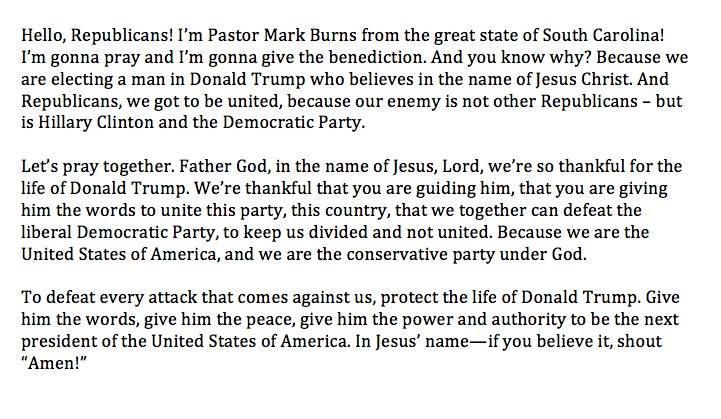
Below is the text of the invocation delivered yesterday at the Republican National Convention in Cleveland, OH:


When I wrote yesterday that I generally hate Presidential election politics and wouldn't be watching the convention, this is exactly why. In the eyes of this pastor - and, one can infer, in the eyes of the Trump campaign, since they have issued no denunciation - the Democratic Party is the "enemy" which must be "defeated" in order to "unite" the country.

This is just shy of calling for a politico-religious holy war. Democrats can only be "defeated" in the sense that they may lose some elections. Whoever wins in November, there will still be tens of millions of Democrats in the United States. How do you propose to "unite" the country once you've declared them the "enemy"?

This is terrible, awful, horrible on so many levels. It's bad politics, it's bad theology, it's bad liturgy. That this man would be invited to give such an invocation, and that these words would not be immediately denounced by the party that invited him, is proof positive that, for the Republican Party as it now stands, politics is no longer about trying to make the country better. It is war, a war against their fellow Americans.

I still choose not to be afraid of a Trump Presidency. And I choose not to be afraid of this man and his words of division and hate, uttered in the name of God. But I am saddened beyond my ability to express that our public square, our most visible civic spaces, have become the playground for hatred, division, and strife. I imagine sometime in the next few days someone at the RNC will refer to Democrats as "cockroaches", and the imagery will be complete.

Wake me in December.

Monday, May 16, 2016

Seeing the World Through a Pinhole

If you follow politics, or the media, or both, you know that there is a long-standing debate about whether the media is politically biased or not. Both Left and Right like to sport bumper stickers and spout made-up epithets, from "lame-stream media" (one of Sarah Palin's favorites) to "corporate media" (a favorite of the Left). A lot of this argument, of course, is to feed martyr complexes on both sides that make each feel paradoxically disadvantaged and empowered by their victimhood at the hands of the supposedly evil media outlets.

The reality, in my view, is much more prosaic. We shouldn't be worried so much about the bias in the media as we should about our reliance on it to understand the world. The problem isn't that the media is slanting the news (they are, though not always in the directions we think), but that we fail to understand the severe limitations of news media at all.

When we talk about the media as a "lens" through which we view the world, we are either using the wrong metaphor or misunderstanding it. Yes, that lens has distortions. Specific outlets may distort based on ideological lines, but there are also distortions based on business decisions - what sells? Fear and anxiety, of course, sell much better than other things, and so we get a steady diet of stories about what's wrong with the world.

This past Sunday my local newspaper ran a story on the front page about an "increase" in "school threats" (incidents of threats made to schools, often as pranks by students). The headline was about how Ohio had more such incidents than any other state in the 2014-15 school year, which of course would make local news. The source of this data? A Cleveland-based consulting company called "National School Safety and Security Services", a company that provides training and consulting to school districts on security issues. How many such "studies" get put into headlines every day, based on bogus or uncorroborated data promulgated by people who have an interest in telling a particular story?

Beyond the specific stories and how they're reported is the question of setting the agenda. This is where the media is truly powerful, but only because we allow them to be. We assume that whatever is on the front page of the paper and what is being talked about on CNN is "what's going on". Transgender bathroom usage in high schools? This was a complete non-issue until somebody grabbed the media bullhorn and decided to make a big deal about it. Yes, schools should treat everybody fairly and bullying stinks. But why is this particular dimension of that problem driving the national conversation? Because somebody with an interest wanted it there.

Some have tried to argue recently that, despite the general national gloom, we're really pretty well off and things are going pretty well. These arguments, though they are likely true, won't go very far because the stories we see - the stories we assume tell us "what's going on in the world" are all bad. It's like looking at the world through a pinhole, or a telephoto lens. Consider this fellow:


He's in the midst of a beautiful location, surrounded by mountains, lakes, forests, and wildlife. How much of that will he capture in the picture he takes? He will no doubt bring back some really beautiful photos - but how much of what he's surrounded by will he have gotten?

I've gone on some amazing hikes, and have taken lots of pictures. Many of them are quite striking; here's one of my favorites:


This is just a tiny piece of the vista you can see from that spot. Depending on what you're interested in, it may not even be the most important piece to you.

Now imagine that someone else is controlling the camera, and they want you to think that you're in a terrible place. How hard would it be to take a dozen images of ugly things and pass those off as representative of the whole? This is what the media does every day - not because they're trying to favor the Left or the Right, but because Ugly sells and reality - which is often messy, complex, and too big to fit on the front page - doesn't.

So when you're reading the local paper, watching cable news, or scrolling through your FB feed, remember that what you're seeing is just a tiny, tiny part of the real world. There's a lot you're NOT seeing. Go out and find some more of that - and remember how big the world is the next time somebody tells you that it fits in a handbasket on its way to hell.

Monday, May 9, 2016

Beyond Fear: A Very Different View of American Presidential Politics

I was quite surprised to discover that the post I wrote last week, "Why I'm Not Afraid of President Trump", has rapidly become the most widely-read piece I've written a long time. In just two days it shot to the top 5 most-read posts on my blog, probably because a number of my FB friends shared it with their networks. Apparently I struck a chord.

I want to continue some of those thoughts from last week because of a confluence of two things. First, a desire to continue the "fear" theme in the post about a possible Trump Presidency. A lot of the subsequent FB chatter about the piece focused on the probable costs of Trump being President, and the various bad things that will happen. Some of these went to significant levels of detail in their predictions, in areas from foreign policy to judicial nominations.

Reading through these discussions made me realize that I hadn't expressed my intended point very well. A part of my argument, it is true, is that a Trump Presidency in reality will likely not be as bad as his worst critics think, much as the Bush and Obama Presidencies were not what their enemies foretold. We never did get Chuck Norris' "Thousand Years of Darkness" by re-electing Obama, and Dick Cheney didn't throw all of his political enemies into concentration camps.

What I meant to say - but didn't articulate very well - is that my decision not to be afraid of the future is not predicated on my ability to predict it. Yes, I have certain hunches about what will or will not happen. Some of those hunches are informed by actual expertise in the study of politics. But as my friend Steve Saideman pointed out recently, even experts get stuff wrong. I recognize that my ability to predict isn't very good. None of us predict the future well, and we tend to project a mishmash of our hopes and anxieties. Confirmation bias is everywhere.

What I should have said but didn't is, I choose not to be afraid not because I know what's going to happen but simply because I choose not to be afraid. I am humble about my ability to predict the future, and completely clear about my ability to affect it (near zero). I don't know what will happen in or after November. Given that situation, fear to me is a choice - I don't have to be afraid, so I choose not to.

There are some things I would like to see happen and some I would like to see not happen, but in the present there is nothing I can do about either. The strength of my preferences doesn't affect the outcome either - whether I mildly dislike The Donald or hate him passionately doesn't make any difference. My choice not to fear is likewise not an indicator of how I feel about Trump or his policies. I find the man and his politics despicable. But I don't have to let his awfulness ruin my day.

This is a position based not at all in politics, but in basic philosophy and self-awareness. The world cannot make me afraid; fear is my response to the world around me. I'm sure there are other circumstances in which I would have much greater difficulty controlling the temptation to fear. Today, for me, is not one of those. I can't speak for anybody else, but that's where I am.

The second event that sparked this particular blog post was a brief blurb I heard on the radio from Trump himself, who told a campaign rally "We're going to go after Hillary." In itself, this was not all that remarkable - had Cruz, or Kasich, or Jeb! been nominated, I imagine any of them would have said the same thing, quite possibly using exactly those words. The issue here isn't Trump, it's our politics in general.

We've been talking for decades about the increasingly personal level of attacks by candidates (and the rest of us) against their opponents. Historians have pointed out that there are ample cases from the 19th century of what we would regard as far more vicious attacks on opponents' character. So one candidate simply saying "we're going to go after" another isn't news.

And that's what strikes me - from a Very Different View - as troubling. Politics has become - perhaps has long been - combat. It's a contest of winners and losers. This is true not only on the surface, in terms of the mechanics of elections, but deep in our DNA. When Karl Rove talked a dozen years ago about a goal of creating a "permanent Republican majority," Democrats were distressed only because they were on the other side - not because the very notion itself, of one side "permanently" defeating the other, violates some very basic principles. We're so steeped in our own broken politics that we can't even see it anymore.

We see this in common political discourse, especially on the internet. How often do we run across a headline in which Person X "destroys" Opposing View Y with a few well-chosen words? This is, of course, verbal nonsense - no rhetoric on my part can destroy anything least of all an idea or a candidate. Yet we casually bandy about this idea of "destruction" every day.

The point here is that, despite our gut feeling otherwise, politics doesn't have to be this way. Communities can, and do, run themselves in far less confrontational and far more inclusive ways. The best examples are local, possibly because it's easier to treat other members of the community like real people when you're in close proximity to them and can interact with them in more authentic ways. Demonization of your opponents requires a certain distance. But distance does not create demonization, it only allows it.

Diversity plays a role here as well, but not in a deterministic way. At this point there's pretty much universal agreement that identities are socially constructed - you're not born being part of any particular kind of group so much as you're raised into a shared set of assumptions. Boundaries can be shifted and changed over time, usually by adopting different practices, patterns, behaviors, and norms.

Without quite realizing it, we have evolved our politics around a single norm: win for "our side" at all costs. This assumes a host of things, including the notion that "winning" is the best thing and that it makes any sense at all, and that we have "sides". This is not the only way to deal with differences of opinion, but we have come to think that it is. This, it seems to me, has become our biggest blindness.

We don't do this as much on an interpersonal level. I don't assault everyone I meet who disagrees with me, either verbally or physically. I know a few people who do, but in general we regard this as boorish behavior. But somehow, we reward and celebrate it in our politics.

So what's the alternative? Any different sort of politics has to start with fundamentals. Our current political habits are built on a set of mutually-reinforcing habits, beliefs, and unexamined norms. To borrow from the trite-but-true, if we want things to be different we have to think differently.

So what needs to change? Let me propose a few basic tenets:

1) All people are people - complex creatures with a dizzying array of characteristics, identities, and life experiences. People are not "Democrats" or "Republicans" - these categories don't define individuals.

2) All people deserve respect as people. This doesn't mean we have to agree on everything, be alike in all ways, or like everything about each other. Respect presumes certain assumptions of both attitude and behavior - we understand in general what it means to "treat someone with respect", and it certainly includes not harming others.

3) Insofar as is possible, politics should be the search for mutual solutions - that is, finding ways of establishing rules and distributing resources that are as close to consensus as can be reached, and that benefit everyone or nearly everyone. A corollary to this is that no one perspective and no one ideology has all of the "right" answers.

If we take the term "politics" out, this is how a great many of us lead our everyday lives. We tend to interact with individuals as individuals, and when we do lump people into undifferentiated categories we usually regard that as a bad thing. We tend to try to treat each other with respect, and when that doesn't happen we regard it as universally inappropriate. And outside of a few structured fields of endeavor, most people most of the time prefer to seek mutual solutions instead of trying to "beat" the other person. Workplaces built around that kind of competition tend to be very bad, both for the people who work there and for the work itself.

I realize that all of these assertions are from my own point of view, and that some will argue with me that "people aren't really like that". This is a debate as old as philosophy itself, and is difficult to gather data on. I'm likely not to convince people with a pessimistic view of human nature. But I have seen enough instances of this in my life to know that it's possible.

What does any of this have to do with one politician's unremarkable comment about "going after" his opponent? That comment shows just how far our politics has gotten away from the tenets I suggest above. We do not search for mutual solutions. We don't respect others. And we tend to reduce complex individuals (either public candidates or simply strangers whom we do not know except that they are on "the other side") to simplistic categories, and then condemn them en masse as such.

Despite being a lifelong student of politics, I dislike most of what we call "politics" for this very reason. We have discarded (to borrow Lincoln's phrase) the better angels of our nature and marinated ourselves in our own worst instincts. We are all poorer for it.

In this regard, the anger and frustration so often written about in this election cycle are entirely understandable. Every two or four years, we are told a Grand Lie: that if only our side wins, if only this or that candidate gets elected, if only the other side is defeated, all will be well. Things will be wonderful. Our nation will be Great Again.

This is nonsense. Our problems will not be resolved if Democrats win all the contests, if Republicans win all the contests, or if the result is some of each. We will be no closer to better mutual solutions; but we will in the meantime be a lot more anxious, and lot more distrustful of and compassionate towards our neighbors, and many of us will be frustrated and angry because "we" "lost".

This is a radically different way of looking at politics, and as such I expect it either won't make sense to many or will strike many as hopelessly naive. I can only point out that our current system of elections and parties seems to be making things worse, not better - and by "things" here I mean not only the overall outcomes of our society but us as individuals. We are, as persons and as a people, worse off because we do this to ourselves every few years.

Radicalism in politics is nothing new, but much of what passes itself off as "radical" is really quite tame. Genuinely radical is telling people to stop judging their neighbors and to attend to their own failings instead (Matthew 7:3). It is telling people to love their enemies (Luke 6:27, Matthew 5:44). It is suggesting that we lay down our lives for each other, not for our own good (John 15:13). Somehow, this kind of radical gets left out when folks suggest that their Christianity informs their politics.

Do I have a solution? Of course not. I pointed out above that I have zero ability to affect the outcomes of our nation. And propounding a solution would be beside the point anyway - saying, "I have the answer" would make me no different from the hordes of huckster politicians and pundits who sell us their wares, trying to make us believe that if only their ideas are adopted, everything will be great. I can't create a good solution; only we can.

This, then, is the conversation I long for: a conversation between people, as people, who can take each other seriously in our own wants, desires, experiences, hopes, and dreams. A conversation aimed at one goal: the discovery of things we agree on, the solutions that help all of us. A conversation in which there are no winners and losers, only participants and citizens. There is no room for that conversation in our current politics. Perhaps we can build one elsewhere.